
Urbex: What Are We Really Searching for in Abandoned Places?
There is something unsettling and exciting about an abandoned place, and yet it may offer calm and serenity too. The exploration of such spaces, “Urbex“, what does it mean, what does it offer, and what does that say about us and our society?
A building that once held conversations, laughter, arguments, work, celebrations and ordinary everyday lives now stands silent. Walls remain, but the people are gone. Furniture gathers dust. Nature slowly finds its way through broken windows and cracked walls.
And yet, some young people are drawn towards these spaces. They enter abandoned buildings, explore forgotten corners and photograph what they find. They call it urbex, or urban exploration.
At first glance, it may seem to be about adventure. But could there be something more?
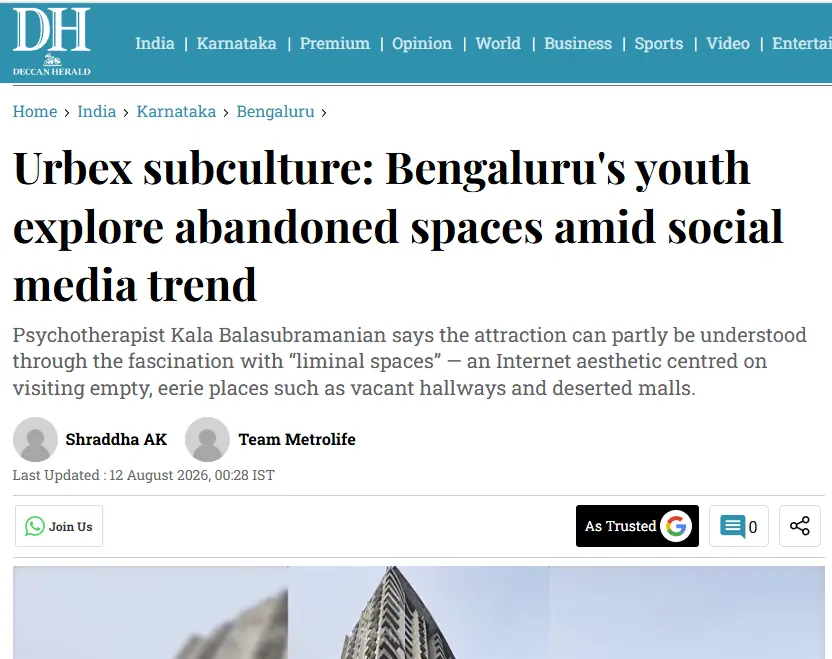
A recent Deccan Herald article, “Urbex subculture: Bengaluru’s youth explore abandoned spaces amid social media trend,” explores this growing interest among Bengaluru’s youth.
Read the full Deccan Herald article
For me, what makes urbex interesting is not simply the abandoned building. It is the person who chooses to enter it.
Why does an abandoned place call out to us?
Perhaps it is curiosity.
What happened here?
Who was here before me?
Why was this place abandoned?
What might I discover if I go a little further?
There is something about entering a space that is usually inaccessible that can create a powerful sense of excitement. The familiar rules of everyday life seem to loosen for a while. For some, it may simply be the joy of exploration. For others, it may be the experience of doing something different from the predictable rhythm of everyday life.
And perhaps, for some young people, it offers something even more important: a feeling of being alive and an escape from the mundane.
The attraction of risk
Risk has always had a place in human behavior. We climb higher. We travel farther. We explore unfamiliar places. We test our limits. A certain amount of risk can make an experience feel vivid and meaningful. But urbex brings an interesting question into the conversation:
When does urbex exploration become risk-taking?
An abandoned building can look harmless from the outside. Inside, the reality can be very different. Floors may be unstable. Staircases may have deteriorated. There may be exposed electrical wiring, broken glass, sharp metal, hazardous materials or unexpected people occupying the space.
And then there is the legal dimension. Some places are private property or restricted areas. The danger is often not visible until it is too late.
This is what makes urbex such an interesting psychological phenomenon. The very uncertainty that creates the excitement can also create the risk.
And then social media enters the room
Urbex existed long before Instagram and TikTok. But social media has changed the experience.
An abandoned building is no longer simply a place to explore. It can become a photograph. The photograph becomes a reel. The reel becomes views. Views can become followers. And suddenly, the experience is no longer only about what I discovered. It can also become about how many people saw me discover it.
Imagine a young person standing on the edge of a risky structure. There may be an internal voice saying,
“This isn’t safe”.
And another voice saying,
“But look at the interesting photographs and reels that can be made”.
Which voice becomes louder when hundreds, or perhaps thousands, of people are waiting to watch? This is where social media deserves our attention. It does not create risk-taking. But it can reward it.
What need is the behavior meeting?
This is the part of the conversation I find particularly important.
As a psychotherapist, I am interested not only in the behavior we can see, but also in what might be underneath it. When a young person repeatedly seeks out risky experiences, it can be tempting to label the behavior as reckless.
But what if we became curious instead?
What is this Urbex experience offering?
The experience can be about excitement, freedom, a feeling of competence/accomplishment, belonging, recognition and more.
Or perhaps it is simply the feeling of stepping outside a life that can sometimes feel too routine, too controlled or too predictable. When we understand the need underneath a behavior, we can have a very different conversation about it.
That does not mean saying that every risk is acceptable. Understanding is not the same as approval. It simply allows us to ask a better question.
Instead of only asking,
“Why are you doing something so dangerous?”
we might ask,
“What are you looking for when you do this?”
That question can open a conversation.
The need to belong
There is another dimension to urbex that is easy to overlook.
People rarely explore in a psychological vacuum. There may be friends who share the interest. There may be online communities. There may be a shared language, shared locations and shared stories.Slowly, an activity can become part of identity.
I explore abandoned places. I am an urbexer.
There is something powerful about belonging to a community that sees the world slightly differently. An abandoned building that most people walk past becomes something else for the explorer. It becomes a story waiting to be uncovered.
And perhaps that is one of the reasons urbex can be so compelling.
It gives people a way of saying:
“I notice what others don’t.” But what happens to the place?
There is also an ethical question here.
An abandoned building may look as though nobody cares about it. But abandonment does not necessarily mean that it has no value.
- It may be part of someone’s history.
- It may have architectural significance.
- It may hold memories.
- And it may still belong to someone.
- Responsible urban exploration therefore requires more than courage.
- It requires boundaries.
Respecting property. Avoiding unnecessary damage. Not taking objects. Not disturbing people who may be living or working there. Being mindful of heritage and safety.
There is a quiet principle often associated with responsible urbex:
Take Permission. Take photographs. Leave the place as you found it.
What are we really exploring in Urbex?
Maybe the most fascinating part of urbex is that the abandoned building is only one part of the story. There is also the person standing inside it.
What draws them there? What are they hoping to experience? What makes the unknown more attractive than the familiar? And what happens when that experience is witnessed, photographed and validated by an online audience?
These are questions worth asking, especially when we talk about young people and risk-taking.
Because if we respond only with warnings, we may miss the conversation underneath the behavior. Young people have always searched for adventure, identity, belonging and experiences that make them feel capable and alive.
So perhaps the question is not simply:
“Why are young people exploring abandoned places?”
Perhaps we could ask:
“What are young people searching for when they go looking beyond the boundaries of the familiar?”
Maybe it is the thrill, curiosity, belonging, recognition and so on.
Maybe it is the need to feel that there is still something undiscovered in a world where so much seems already mapped, photographed and shared.
Urbex may take us into abandoned buildings.
But perhaps the more interesting exploration is the one that happens within.
What are we willing to risk in order to feel alive, seen and connected?
And perhaps that is a question worth stepping into carefully.
Read the full Deccan Herald article
Urbex subculture: Bengaluru’s youth explore abandoned spaces amid social media trend
About the Author
Kala Balasubramanian is a Psychotherapist, CTA (Certified Transactional Analyst), PTSTA (Psychotherapy), Trainer, Supervisor, and Founder of Inner Dawn Counselling and Training Services LLP. She works with individuals, couples, groups, and organizations to foster emotional well being, healthier relationships, resilience, and psychologically safe workplaces. Her work focuses on helping people understand the impact of stress, relationships, communication patterns, and emotional health on everyday life.