
Bullying, Scars that last from school to adult life
Many adults carry invisible wounds that had their origins in their childhood. They began in a classroom, playground, neighbourhood, and other spaces. For many children, bullying is not a passing phase. It is an experience that quietly shapes how they see themselves, how they trust others, and how they navigate relationships for years to come.
A cruel nickname repeated every day. Being left out of every game. Rumours whispered behind their back. Teachers dismissing concerns as “children being children.” Parents being told their child is “too sensitive.”
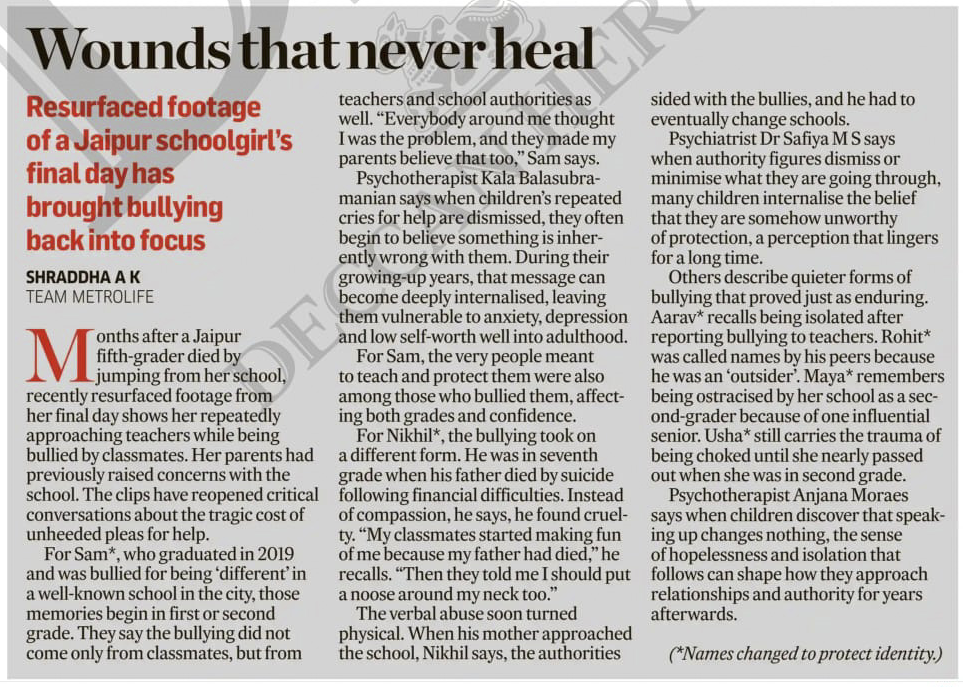
The recent Deccan Herald article, “When Cries for Help Go Unheard: The Lifelong Scars of School Bullying,” brings attention to this often-overlooked reality through the stories of survivors whose emotional pain continued long after they left school. My views on the psychological impact of bullying were featured in the article, highlighting why children’s pleas for help should never be dismissed.
Bullying Doesn’t End When School Ends
Many people assume that childhood bullying is something children eventually “grow out of.”
The truth is more complicated. While the bullying may stop, the situation may change over time, yet the beliefs children develop about themselves often remain.
Children naturally depend on adults to help them make sense of difficult experiences. When those adults fail to recognise or respond to bullying, children frequently draw painful conclusions:
- Something must be wrong with me.
- I deserve to be treated this way.
- Nobody will protect me.
- Speaking up doesn’t help.
These beliefs rarely stay confined to childhood. They often become the foundation for anxiety, depression, low self-esteem, perfectionism, people-pleasing, over-compensation, difficulties trusting others in adulthood, etc.
When Children’s Cries for Help Go Unheard
In the Deccan Herald article, I shared an observation I see repeatedly in therapy:
When children’s repeated cries for help are dismissed, they often begin to believe something is inherently wrong with them. During their growing years, this message can become deeply internalised, leaving them vulnerable to anxiety, depression and low self-worth well into adulthood.
This is perhaps one of the most damaging consequences of bullying. The child is no longer only fighting the bully. They begin fighting themselves. Their inner dialogue slowly becomes another bully, criticising, doubting and blaming them long after the original bullying has ended.
Isolation or being excluded Can Hurt as Much as Physical Bullying
When people think about bullying, they often imagine physical aggression. But emotional exclusion can be equally devastating. Being deliberately ignored, excluded from group activities, classmates who refuse to speak to you, erstwhile friends now no longer. Watching everyone else belong while you stand alone.
Social isolation sends a powerful psychological message to children: You don’t belong.
Because human beings are wired for connection, repeated experiences of exclusion activate the same emotional pain pathways associated with physical injury. This can result in feelings of loneliness, shame, social anxiety and chronic self-doubt that persist for years or may show up when facing stressful situations even in adulthood.
The Long-Term Mental Health Effects of Bullying
Research consistently shows that prolonged bullying increases the risk of:
- Anxiety disorders
- Depression
- Low self-esteem
- Social anxiety
- Difficulty trusting others
- Challenge managing emotions
- Relationship challenges
- Self-harm and suicidal thoughts in severe cases
Many adults seeking therapy today are not simply processing recent stress. They are revisiting experiences from childhood that were never acknowledged or healed.
Why Some Children Never Tell Anyone
Adults often ask
“Why didn’t they tell someone?”
Many children do.
The bigger question is:
“What happened after they did?”
When their concerns are minimised…
If they’re told to “ignore it”…
Or teachers defend the bullies or don’t take it seriously…
If parents dismiss it as normal…
Children quickly learn that asking for help is unsafe. Silence becomes a survival strategy. Ironically, this silence is many a time mistaken for resilience.
What Parents and Schools Can Do Differently
Preventing lifelong emotional harm requires more than anti-bullying policies. It requires availability of emotionally safe adults for children. Parents and educators can make an enormous difference by:
- Taking every report of bullying seriously. Offering a safe space for children to express their feelings and share their experiences/
- Listening without immediately offering solutions or judgment. The more the adults are into devices, the less listening the children get.
- Looking beyond physical injuries to notice emotional withdrawal or any significant changes in behaviour.
- Encouraging children to describe their experiences without fear of blame.
- Responding consistently rather than treating incidents as isolated events.
- Taking appropriate action commensurate to the incident. Teachers can discuss with colleagues and seniors to arrive at solutions.
- Having a firm policy around bullying and ensuring that all students, teachers and parents are aware of it and collaborate to ensure a safe environment for all.
- Creating classrooms where empathy and inclusion are actively practised.
Children may forget every lesson taught in school. But they rarely forget whether they felt safe there.
Healing Is Possible
Adults who experienced bullying often believe they should have “moved on by now.” Healing doesn’t happen because time passes. Healing happens when painful experiences are finally understood, validated and processed.
Therapy can help people recognise that the shame they carry was never theirs to begin with. As they rebuild self-worth and healthier ways of relating to others, many discover that their childhood no longer has to define their future. The scars may tell a story, but they do not have to write the ending.
Read the Full Article
My comments on the lifelong psychological impact of school bullying were featured in the Deccan Herald article:
When Cries for Help Go Unheard: The Lifelong Scars of School Bullying
Final Thoughts
Bullying is often dismissed as a childhood experience that children will eventually “grow out of.” Yet for many adults, the echoes of those experiences continue to influence confidence, relationships and mental wellbeing decades later.
Every child deserves to know that when they speak up, someone will listen and that they will be believed and supported in their difficult experience. Because sometimes the most powerful intervention is not having the perfect answer. It is making sure a child never has to feel alone in their pain.
About the Author
Kala Balasubramanian is a Psychotherapist, CTA, PTSTA (Psychotherapy), Trainer, Supervisor, and Founder of Inner Dawn Counselling and Training Services LLP. She works with individuals, couples, groups, and organisations to foster emotional wellbeing, healthier relationships, resilience, and psychologically safe workplaces. Her work focuses on helping people understand the impact of stress, relationships, communication patterns, and emotional health on everyday life.