
Damage from social media on children and adolescents
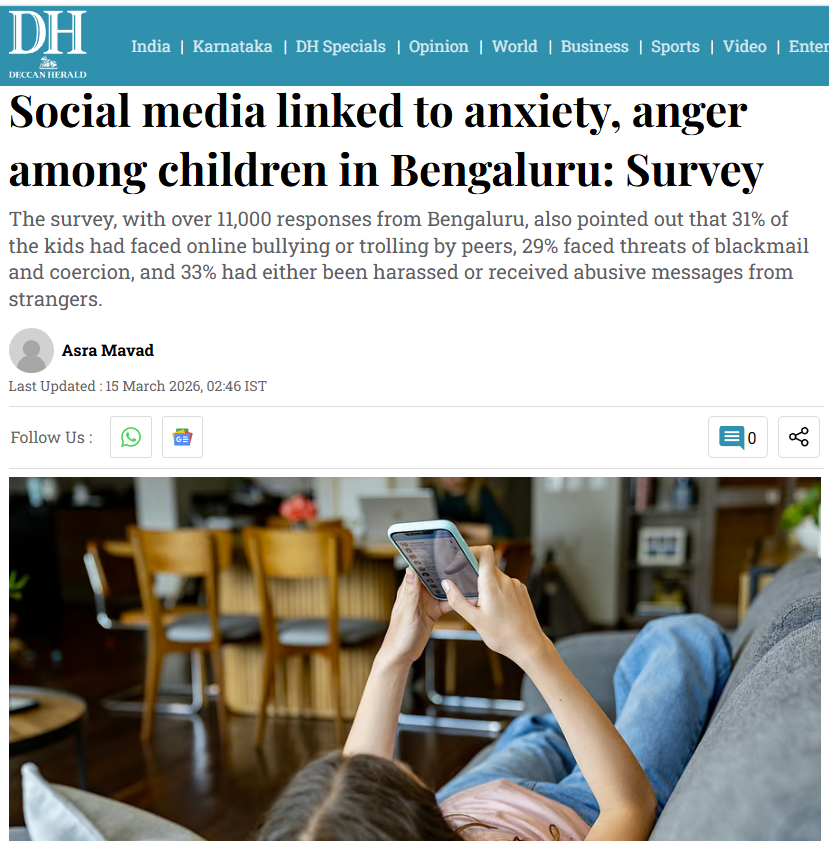
A recent survey in Bengaluru has sparked urgent conversations among parents, educators, and mental health professionals. With over 11,000 responses, the findings reveal a concerning emotional landscape for children navigating social media and the digital world.
👉 Read the full article here: https://www.deccanherald.com/india/karnataka/bengaluru/social-media-linked-to-anxiety-anger-among-children-in-bengaluru-survey-3932228
Inner Dawn counsellor Kala Balasubramanian’s views featured in Deccan Herald on the 15th March 2026.
What the survey reveals
The data paints an unsettling picture of children’s online experiences:
- 41% of families reported children experiencing fear and anxiety due to negative online interactions
- 31% of children faced cyberbullying or trolling
- 29% encountered blackmail or coercion
- 33% received abusive messages from strangers (Deccan Herald)
This isn’t just about screen time anymore. It’s about physical and emotional safety in digital spaces.
The psychological impact of social media
Social media, when unregulated, is a space of comparison, validation-seeking, and exposure to harm. Children and adolescents are especially vulnerable because their emotional regulation systems are still developing.
The survey links social media exposure to:
- Increased anxiety and fear
- Rising anger and irritability
- Heightened sensitivity to peer validation and rejection
- Exposure to online trolling and bullying
- Online grooming, manipulation, and abuse by catfishing
- Exposure to age-inappropriate content
Over time, this can shape self-worth, relationships, identity and attention span. It also impacts the capacity for empathy adversely and the quality of real-world connections.
Psychotherapist Kala Balasubramanian’s perspective
Inner Dawn counsellor Kala Balasubramanian offers a nuanced understanding that moves beyond blaming technology.
- Social media often amplifies existing emotional vulnerabilities, rather than creating them in isolation
- Children lack the psychological tools to process online hostility, making even minor incidents feel overwhelming
- The digital world can blur boundaries, where private emotional experiences become public and persistent
- When children are exposed to screens and online content very early, they get hooked on the dopamine-based addictive content and games. Social media, short-form videos, and games act like digital drugs, offering dopamine hits through instant rewards and stimulation.
- Mobiles and screens have become the ubiquitous digital pacifier that parents today offer to young children
- When parents themselves immerse themselves in their mobile phones and screens, it is not surprising that the children are as well.
The conversation cannot be just about restricting access alone, but about building emotional resilience and digital literacy. Beyond the laws, as a society, we need to take responsibility in our own families, as parents and caregivers.
Why addressing the impact of social media on children matters more than ever
Today’s children are growing up in a hybrid reality where offline and online worlds constantly overlap. A conflict in school doesn’t end at the school gate, it can follow them home through social media and notifications.
Instead of policing screens, can we invite open conversations.
- Create open conversations about online experiences without judgment
- Teach children to recognise unsafe interactions and seek help
- Encourage critical thinking rather than passive consumption
- Model healthy tech boundaries at home
Moving forward: From control to connection
Social media isn’t going away. Laws are being considered to restrict the usage of social media for youngsters. The goal is not to raise children who fear the digital world, but those who can navigate it with awareness, confidence, and emotional grounding.
Are you concerned about how mobile usage and social media is impacting your child?
Let’s start a conversation. Reach out to explore how therapy and guidance can support your child’s emotional well-being in a digital age. But long before there comes the need for therapy, I believe it is important for parents to build awareness as to the impact of screens and social media on their wards and to address these patterns at the earliest.