
Road Rage: Actions by Bengaluru Police, What more is needed.
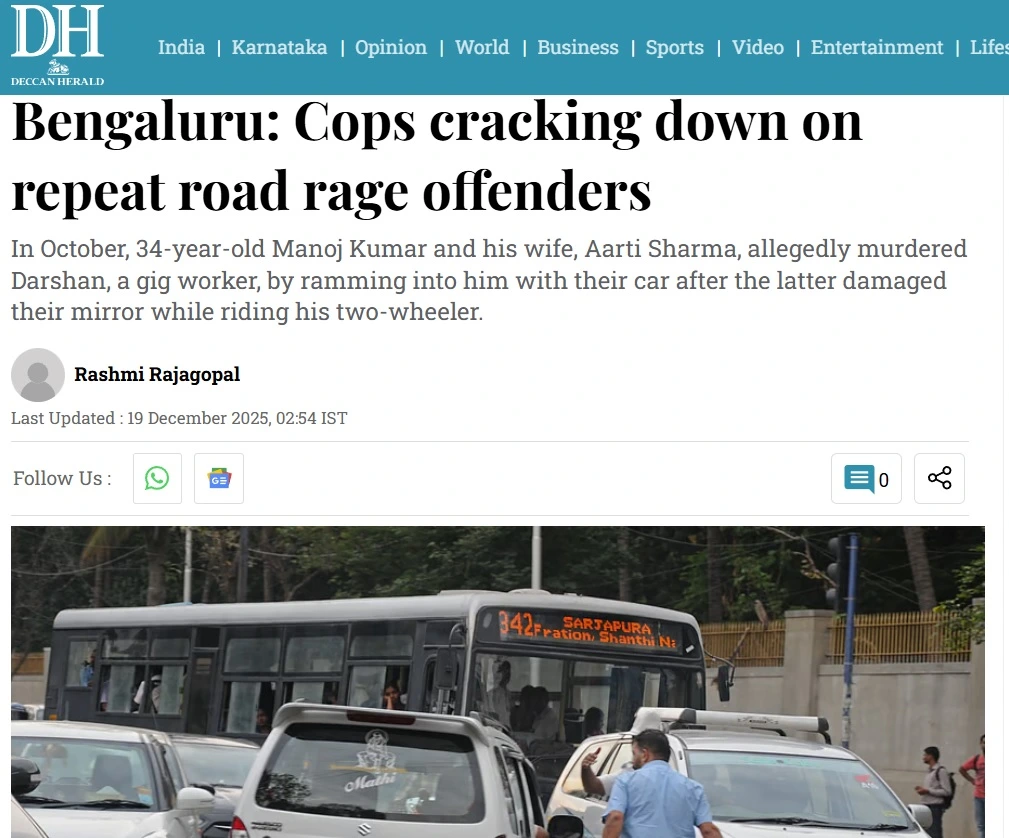
Urban traffic isn’t just a daily grind. For many Bengaluru commuters, it’s a pressure cooker where tempers flare, and frustrations spill over into dangerous on-road confrontations. According to a recent Deccan Herald report, law enforcement in the city is now aggressively targeting repeat road rage offenders in an effort to make streets safer for everyone.
Inner Dawn counsellor Kala Balasubramanian’s views featured on Deccan Herald on 19-Dec-25
The Road Rage Reality in Bengaluru
Bengaluru’s fast-paced lifestyle and busy roads make it fertile ground for commuter stress. But when frustration turns into aggressive driving, i.e., honking, tailgating, verbal threats or even physical altercations, it’s no longer just stress; it’s a public safety issue.
Police authorities have acknowledged a rising trend of repeat offenders who exhibit dangerous road behaviour and have pledged to intervene more robustly to prevent escalation.
Road rage is a lived reality for millions of city drivers, passengers, delivery workers and pedestrians. The consequences can be increased risk of traffic accidents, stress and anxiety for regular commuters, escalation into violent confrontations, damage to property and public infrastructure etc.
By cracking down on repeat offenders, Bengaluru officials are signalling that irresponsible driving behaviour will not be tolerated, and that roads are shared spaces requiring mutual respect.
What the Police Action Entails
The crackdown includes several key components designed to curb repeat offences and change driving culture over the long term:
- Identification of repeat offenders: Traffic cops are monitoring and logging drivers involved in multiple road-rage incidents.
- Stricter enforcement: Repeat offenders face heavier fines, penalties and possible legal action.
- Public awareness campaigns: Police are educating motorists on safe driving etiquette, and the legal repercussions of aggressive behaviour on the road.
The objective shouldn’t be just punishment. It needs to be deterrence and behaviour change, ensuring that public roads are safe for families, commuters, two-wheelers and pedestrians alike.
Are laws and enforcement enough to make safer roads?
As a Psychologist, I believe that many times, the emotions that are piled up in different situations can get violently expressed on the road as rage.
For example, if you are frustrated at work with a co-worker or angry with a family member at home, and you are not able to express it appropriately to them, or repeated instances of frustration get piled up within, then it can get displaced onto the road at other commuters.
It is important to understand the emotional triggers that lead to aggression. Understanding our own emotions, finding ways to regulate them allows us to respond appropriately to not just our own emotions but also to others empathically.
I believe that legislation alone is inadequate. Enforcement needs to be consistent. Having said that, we need to learn and teach Emotional Literacy/Emotional Regulation/Appropriate Expression/Empathy at school and at home.
When these elements work together, the outcome can be a culture shift in driving norms, not just a temporary crackdown.